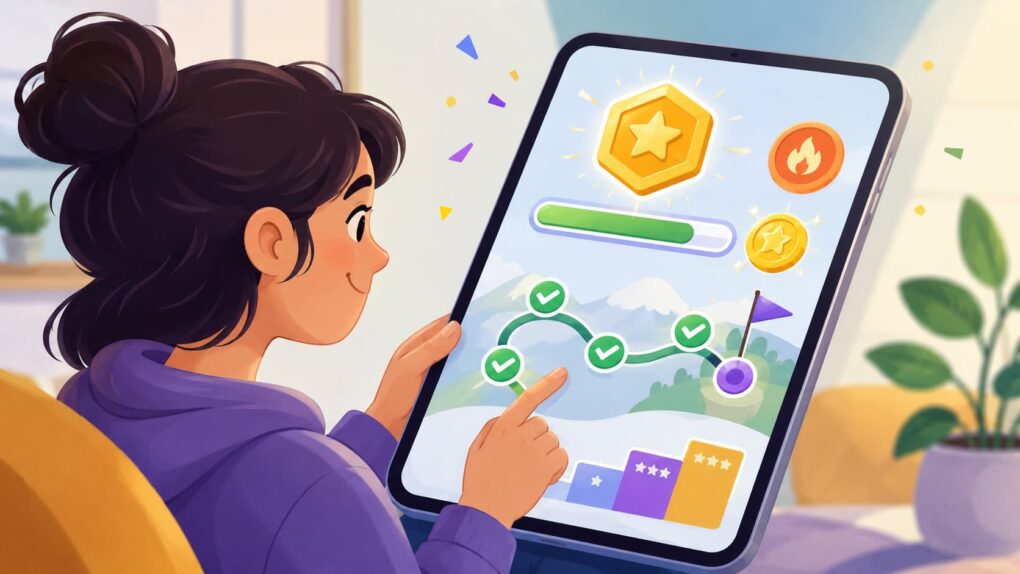
Open almost any modern app and you will feel something familiar. A progress bar that fills as you complete tasks. A badge that lights up when you close a daily goal. A streak counter that begs you not to break the habit. None of this came from the world of banking, fitness, or education. It is the language of video games, carefully transplanted into products that do not think of themselves as games at all. Game developers have spent decades learning how to hold a person’s attention and turn routine into pleasure, and their discoveries are now spreading far beyond the entertainment industry.
Why apps started borrowing from games
The reason is simple and practical. Games learned to solve a problem that every product struggles with – how to make a person come back tomorrow. App stores are overcrowded, user attention is split across dozens of tabs, and holding on to it grows harder every year. Game studios ran into this problem earlier than everyone else, because their product is worthless without engagement. Nobody pays for a game they do not want to play.
Out of that necessity grew a whole science of motivation. Developers found that a person is more willing to continue when they see progress, receive feedback, and feel that effort leads to reward. These principles turned out to be universal. They work equally well in a dungeon full of monsters and in a language-learning app. So product teams outside the game world began studying that experience and borrowing what had already proven effective.
Progress bars and the power of visible advancement
The first thing to migrate from games was the sense of moving forward. In games, progress is always visible. The experience bar grows, the level rises, the map opens up as you advance. A person always knows where they stand and how far it is to the next milestone.
Apps adopted this trick almost word for word. A meditation service shows how many minutes you have accumulated. A learning platform draws a path of completed lessons. Even a banking app now displays how close you are to a savings goal. The secret is that visible progress works more strongly than abstract progress. The phrase “you have finished seventy percent of the course” motivates far better than a dry list of remaining tasks, because the brain hates abandoning a nearly finished job. Game developers understood this long ago, and product teams simply took the ready-made solution.
Rewards, points and the loop of small wins
The second major borrowed mechanism is the reward for action. In games, every effort is reinforced with something tangible. Kill an enemy and get gold. Clear a level and unlock a new weapon. This loop of action and reward is gripping, because the brain reacts to small victories with a burst of satisfaction.
Non-game apps have built similar loops. A fitness tracker showers you with badges for the steps you take. A language service awards points for each completed lesson. A productivity app marks finished tasks with animation and sound. The points themselves are worth nothing – they cannot be exchanged for real money. But psychologically they work, because they turn invisible effort into a tangible result. People enjoy seeing their work acknowledged, even when the acknowledgement comes from a strip of pixels on the screen.
What matters is that skilled developers meter the rewards. If you praise a user for every trifle, the praise loses value. Games long ago found the balance – a reward should be earned yet achievable. Apps that adopt this trick consciously rather than mechanically achieve a better effect.
Streaks and the fear of breaking the chain
The streak mechanic deserves a separate conversation. In games it goes by different names, but the essence is one – a continuity you would hate to interrupt. Language-learning apps made the streak their signature move. Practice every day and the counter climbs. Miss a day and everything resets to zero.
This mechanic leans on a curious quirk of the human mind. People fear losing what they have already accumulated more than they enjoy gaining something new. A long streak becomes a small achievement people treasure, and the thought of resetting it drives them to open the app even on a tired evening. Game developers used a similar logic in daily login rewards, and product teams picked up the idea.
Streaks also have a downside that honest developers keep in mind. A mechanic that is too harsh can turn a useful habit into a source of anxiety. When a person practices not because they want to but because they fear losing a number, the app starts to pressure rather than help. That is why mature products add softening elements – the ability to freeze a streak or make up for a missed day. This too is a lesson from games, where good design cares that the player feels fairness rather than punishment.
Levels, unlocks and the sense of growing skill
Another borrowed technique is the gradual unveiling of features. In games, a newcomer is not handed the entire arsenal at once. Difficulty and features open up as the player grows, so the person does not get lost and feels they are developing alongside the game.
Apps adopted this gentle delivery. A learning service starts simple and gradually raises the difficulty, opening new topics only when the previous ones are mastered. Professional tools hide advanced settings until the user gets comfortable with the basics. This approach lowers the barrier to entry and creates a pleasant sense of mastery that grows step by step. A person feels they are climbing through levels, even though what stands before them is not a game but a spreadsheet editor or a finance app.
Where borrowing helps and where it backfires
Borrowing game techniques is not a universal cure. It helps when it reinforces what a person already wants to do. For someone sincerely intent on learning a language or getting in shape, progress bars and rewards give an extra push on hard days. Here the game layer serves as support, not a replacement for meaning.
The trouble begins when the techniques are applied thoughtlessly. A badge glued to a meaningless action quickly grows dull. Aggressive notifications that press on guilt breed irritation and rejection. A reward divorced from real benefit turns into manipulation, and the user senses it. The best products understand the difference. They borrow from game developers not only the mechanics but also the respect for the human on the other side of the screen – the principle that engagement should be honest, not squeezed out at any cost.
What the future holds
The line between games and ordinary apps keeps blurring. Tools that seemed strictly businesslike until recently now take game elements ever more boldly, while games in turn borrow ideas from education and health. This exchange enriches both sides and makes digital products more alive.
The main takeaway for those who build apps sounds like this. From game developers it is worth learning not individual tricks but a way of thinking. Games respect a person’s time and attention, reward their effort, and make the path to a goal visible and pleasant. An app that adopts this philosophy rather than merely scattering badges gains not only retention but also trust. And in an overcrowded world of digital products, trust is worth more than any progress bar.